Insurance Coverage for Autism Treatments Sought
February 25, 2009
Patient advocates called on state regulators Tuesday to force health insurers to cover certain autism treatments.Consumer Watchdog in Santa Monica sent a letter to Cindy Ehnes, executive director of the state Department of Managed Health Care, and her boss, Gov. Arnold Schwarzenegger, expressing concern about delays in resolving coverage complaints from parents of autistic children.
Consumer Watchdog founder Harvey Rosenfield said in the letter that state laws require the department to take swift action on the parents' complaints and that delays could exacerbate the children's condition.
Autism is a disorder that impairs communication and socialization. Its cause is unknown. There is no cure. But experts and public health authorities say that the disputed behavioral therapy is effective, especially when started at an early age, at mitigating symptoms and improving self-sufficiency.
Then, late last year, Kaiser Permanente, the state's largest nonprofit health insurer, changed its rationale for denying the coverage.
Instead of saying the treatment is not medically necessary, Kaiser now says the therapy is not covered because it is educational and not medical.
The new tactic prompted the department to put several treatment disputes on hold while it considered how to respond.
"The proper handling of Independent Medical Reviews for autism coverage has been a high priority for the DMHC, and the issues in these cases are highly complex, as are most issues concerning autism," said Department of Managed Health Care spokeswoman Lynne Randolph.
"Children with autism and their families deserve a complete examination by the DMHC of all complexities of these cases, which is what we have been providing," Randolph said.
The department's reconsideration of the disputes stoked concern among parents and patient advocates that it might allow insurers to avoid covering the treatments.
Rosenfield threatened to sue the department if it retreated.
"There are no exceptions to the legal requirement that the plans provide coverage for 'medically necessary' treatment to autistic patients . . . no matter what the [insurers] cynically attempt to call it," Rosenfield said in the letter to the department.
The new pressure on regulators raises the stakes in an ongoing controversy over treatment for children with autism.
Parents of autistic children have filed at least two class-action lawsuits against Kaiser in recent months, accusing the insurer of using a series of sham excuses to deny treatment in order to avoid the expense.
Charles Bacchi, interim president of the California Assn. of Health Plans, said that requiring insurers to cover behavioral therapy would drive up everyone's premiums.
"We believe that health plans provide comprehensive coverage for autism related medical services for parents and children every single day," he said. "However, educational services, we believe, are more appropriately covered by schools and [government] regional centers."
Like the association, Kaiser has "asked the department for clarity surrounding the department's views about sending coverage disputes of non-healthcare services to" independent physician review panels, said Jim Anderson, a spokesman for Kaiser.
For more information about autism, visit www.centerforautism.com
What do you think about this latest LA Times article on autism insurance coverage?
We'd like to hear from you.
Share your comments below.
Teen's Family Transformed After Autism Intervention
By Linda Saether CNN
Until recently, the Bilson household was under siege. Thirteen-year-old daughter Marissa, who has autism, ruled the roost, screaming shrilly until she got her way and enjoying special privileges that didn't extend to her siblings, Brittany, 15, and Brendan, 6. These days inside the Bilsons' cozy house, there is a lot less screaming and more boundaries are in place. The balance of power is tipping back into the hands of the parents and away from Marissa and her tantrums.
New Study Further Disputes Vaccine-Autism Link
A new study from Italy adds to a mountain of evidence that a mercury-based preservative once used in many vaccines doesn't hurt children, offering more reassurance to parents.In the early 1990s, thousands of healthy Italian babies in a study of whooping cough vaccines got two different amounts of the preservative thimerosal (pronounced thih-MEHR'-uh-sawl) from all their routine shots.
Ten years later, 1,403 of those children took a battery of brain function tests. Researchers found small differences in only two of 24 measurements and those "might be attributable to chance," they wrote in the February issue of the journal Pediatrics, which was released Monday.
Only one case of autism was found, and that was in the group that got the lower level of thimerosal.
Autism is a complex disorder featuring repetitive behaviors and poor social interaction and communication skills. Scientists generally believe genetics plays a role in causing the disorder; a theory that thimerosal is to blame has been repeatedly discounted in scientific studies.
"Put together with the evidence of all the other studies, this tells us there is no reason to worry about the effect of thimerosal in vaccines," said the new study's lead author, Dr. Alberto Tozzi of Bambino Gesu Hospital in Rome.
The debate over thimerosal and autism has been much stronger in the United States than in Italy, Tozzi said. But the researchers recognized a chance to examine the issue by going back to the children who had taken part in the 1990s whooping cough research.
Randomization sets the new study apart. The random assignment of children rules out the chance that factors other than thimerosal, such as education or poverty, caused the results.
Thimerosal, used in some vaccines to prevent the growth of bacteria and fungus, hasn't been in U.S. childhood vaccines since 2001, except for certain flu shots. Italy and other European nations began removing it in 1999. U.S. health officials recommended the removal of thimerosal as a precaution and to reduce the overall exposure of children to mercury.
Safety regulations still require multi-dose vials of vaccines to contain some type of preservative to prevent the spread of infection from contaminated vials.
The study, funded by the U.S. Centers for Disease Control and Prevention, drew praise from outside experts.
" It's yet another well done, peer-reviewed research study that has demonstrated there is no risk of any neurodevelopmental outcomes associated with thimerosal in vaccines," said epidemiologist Jennifer Pinto-Martin of the University of Pennsylvania.
"This becomes the fourth study to look for subtle signs of mercury toxicity and show the answer was 'no,'" said Dr. Paul Offit, chief of infectious diseases at the Children's Hospital of Philadelphia, the author of a book on autism research and the co-inventor of a rotavirus vaccine.
Tozzi said comparing children with no exposure to thimerosal could have improved the study.
"However, if thimerosal were a cause of harm, it is likely that this effect would increase with the
administered dose," he said.
The children received either 62.5 micrograms or 137.5 micrograms of ethyl mercury from all their shots during their first year of life. Thimerosal breaks down as ethyl mercury in the body. Before the reduction of thimerosal in the United States, the maximum exposure for infants was 187.5 micrograms of ethyl mercury.
The researchers found the children in both groups scored, on average, in the normal range on 11 tests of memory, attention, motor skills and other brain functions.
Those 11 tests included 24 measured outcomes. Small, but statistical differences were found for only two of those areas, and only for girls. The girls with higher exposure scored worse on a finger-tapping test with their dominant hands, and on a vocabulary test in which they were asked to name common objects.
There was no difference in boys on those outcomes or others. Researchers also found no difference in tic disorders. And the one autism case found in the lower-intake group was likely a chance finding, Tozzi said.
CARD Reveals Outcome of First Arizona Early, Intensive Behavioral Therapy Study
Amy Kenzer, PhD, BCBA, CARD’s manager of Research and Development says, “At this point, all of the children in the Arizona grant have received services for approximately a year and a half. Following one year of treatment, several children showed significant improvements as measured by standardized assessments and parent report, including two children who gained 50 IQ points. Many of the children also started full day Kindergarten this fall and are doing very well in their new classrooms.”Dr. Amy Kenzer, Research and Development Manager at the Center for Autism and Related Disorders, has over 10 years of experience in the field of Behavior Analysis and Autism.
The Center for Autism and Related Disorders, Inc. (CARD) was established in 1990 and is among the world's largest and most experienced organizations effectively treating children with autism and related disorders. CARD operates 20 satellite offices throughout the United States and abroad. CARD has treated thousands of children around the world. Its services include assessments, supervision, parent/teacher training and one-to-one therapy.
CNN Top News Stories of 2008
Debate over the causes of autism continued to rage after a court decided to compensate a family whose daughter developed the disorder after receiving childhood vaccinations.
For years, some parents have contended that childhood vaccinations cause autism.
But studies published in the New England Journal of Medicine and elsewhere have found no link between autism and vaccines. Additionally, the Centers for Disease Control and Prevention, the American Academy of Pediatrics, the Institute of Medicine and other medical organizations have repeatedly asserted that vaccines are safe.
CARD SKILLS ©
Available 2009!
E-Learning
Provides training in ABA and how it is used to teach skills to children with autism. It is composed of on-line training modules which focus on topics such as:
- Autism and how it is diagnosed
- Introduction to ABA and its principles
- Assessment and identification of skill targets
- Teaching Paradigms
- Natural Environment Training (NET)
- Discrete Trial Training (DTT)
- Fluency-Based Instruction (FBI)
- Procedures
- Discrimination training
- Prompting and Fading
- Shaping
- Chaining
- Generalization and Maintenance
- Functional behavioral assessment (FBA)
- Interventions for challenging behavior
- Data collection
"The CARD E-Learning series won't make a user a pro overnight, but it will teach basic skills and information to establish a foundation in which a user can build with proper supervision,” said Dr. Adel Najdowski, CARD Research and Development Manager and co-creator of CARD SKILLS."We recommend that users work along side a CARD Supervisor in order to gain the most value from CARD SKILLS. Once a trainee finishes an e-learning module, he or she must take and pass a quiz before moving on to the next training module. Then, once a trainee completes all modules of the e-learning, he or she is ready to begin using (with supervision) behavioral analytic techniques to teach skills to children with autism."
CARD’s SKILLS Index is the alternative to the complex myriad of psychological, cognitive, and intelligence tests.SKILLS Index
The SKILLS Index is an assessment tool comprised of a series of yes or no questions that the behavioral educator answers about the child.
The questions are organized by skill area and listed in chronological order of child development across eight domains:
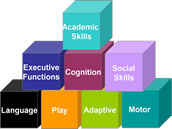
Language, Play, Adaptive, Motor, Executive Functions, Cognition, Social, and Academic Skills
Answers to the assessment questions are logged in a computerized database which automatically produces simple bar graph reports identifying skills that are in the child’s repertoire versus those that need to be taught. The report is relevant to the child’s age and is summarized according to skills that the child’s same-age peers would exhibit.
“CARD SKILLS is like no other product because of its comprehensiveness,” said Dr. Doreen Granpeesheh, CARD Founder, Executive Director, and Co-Creator of CARD SKILLS.
CARD's Curricula includes lessons to teach skills in each of the eight skill domains assessed in the SKILLS Index.
CARD's Curricula
- Average age ranges for when skills develop
- Prerequisites necessary before teaching the skills in the lesson
- Type of nonverbal or verbal operant that is being taught
- Sample Individual Education Plan (IEP) goals related to the skill
- Ideas for setting up teaching materials and scenarios
- Teaching points for ensuring the child’s success in learning targeted skills
- Ideas for programming for generalization
- Direction for what to teach next


